

For the pain physician, Urine Drug Testing (UDT) is not a tool for "catching" patients; it is a...
Headache Disorders: Diagnosis and Management of Common Primary Headaches
Headaches are among the most common neurological complaints, affecting a vast proportion of the global population. While many headaches are benign and self-limiting, some represent severe, debilitating conditions that significantly impair quality of life and productivity. For pain medicine providers, a comprehensive understanding of headache classification, diagnostic criteria, and evidence-based management strategies for primary headache disorders (those not caused by another condition) is essential. This article will review the three most prevalent primary headache types: tension-type headache, migraine, and cluster headache.
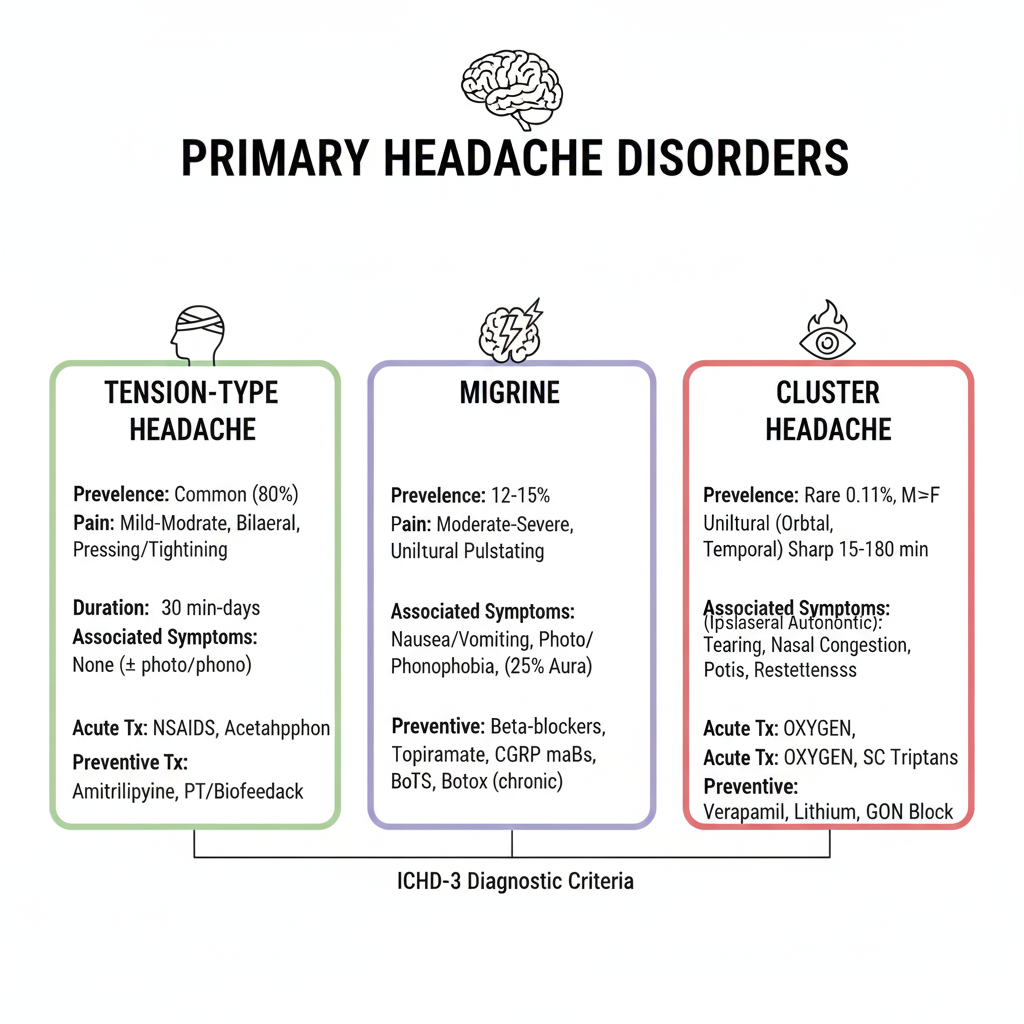
I. Tension-Type Headache (TTH)
TTH is the most common type of primary headache, characterized by mild to moderate pain that is often described as a tight band around the head.
- Epidemiology: Affects up to 80% of the population at some point in their lives.
- Pathophysiology: Largely attributed to pericranial myofascial pain and central sensitization. Psychological stress, anxiety, and depression are significant contributing factors.
- Diagnostic Criteria (ICHD-3):
- Headache lasting from 30 minutes to 7 days.
- At least two of the following characteristics:
- Bilateral location.
- Pressing or tightening (non-pulsating) quality.
- Mild or moderate intensity.
- Not aggravated by routine physical activity.
- Both of the following:
- No nausea or vomiting.
- No more than one of photophobia or phonophobia.
- Not better accounted for by another ICHD-3 diagnosis.
- Management:
- Acute Treatment:
- First-line: Simple analgesics like acetaminophen (paracetamol) or NSAIDs (ibuprofen, naproxen).
- Avoid frequent use to prevent medication overuse headache (MOH).
- Preventive Treatment (for chronic TTH, >15 days/month for >3 months):
- Tricyclic Antidepressants (TCAs): Amitriptyline is considered first-line, even in non-depressed patients, due to its analgesic and muscle-relaxant properties.
- Stress management, biofeedback, physical therapy, and acupuncture.
- Acute Treatment:
II. Migraine
Migraine is a debilitating neurological disorder characterized by recurrent episodes of moderate to severe headache, often accompanied by autonomic symptoms.
- Epidemiology: Affects approximately 12-15% of the general population, more common in women.
- Pathophysiology: A complex neurobiological disorder involving central nervous system hyperexcitability, cortical spreading depression (CSD), and activation of the trigeminal pain pathway (trigeminovascular system). Neurotransmitters like serotonin and calcitonin gene-related peptide (CGRP) play crucial roles.
- Phases of a Migraine Attack (not all patients experience all phases):
- Prodrome (Pre-headache): Occurs hours to days before the headache. Symptoms include fatigue, mood changes, neck stiffness, yawning, food cravings.
- Aura: Occurs in ~25% of migraineurs, usually before the headache. Most commonly visual (e.g., scintillating scotomas, zigzag lines), but can be sensory, motor, or speech-related. Lasts 5-60 minutes.
- Headache Phase: Moderate to severe, unilateral (often but not always), pulsating pain. Aggravated by physical activity, accompanied by nausea/vomiting, photophobia, phonophobia, and osmophobia. Lasts 4-72 hours.
- Postdrome (Post-headache): “Migraine hangover” with fatigue, difficulty concentrating, neck stiffness, or residual pain.
- Diagnostic Criteria (ICHD-3 for Migraine without Aura):
- At least 5 attacks fulfilling criteria 2-4:
- Headache attacks lasting 4-72 hours (untreated or unsuccessfully treated).
- Headache has at least two of the following:
- Unilateral location.
- Pulsating quality.
- Moderate or severe pain intensity.
- Aggravation by, or causing avoidance of, routine physical activity.
- During headache, at least one of the following:
- Nausea and/or vomiting.
- Photophobia and phonophobia.
- Not better accounted for by another ICHD-3 diagnosis.
- Management:
- Acute (Abortive) Treatment:
- Non-specific: NSAIDs, acetaminophen, antiemetics.
- Specific:
- Triptans (serotonin 5-HT1B/1D agonists): Sumatriptan, zolmitriptan, etc. Potent vasoconstrictors; contraindicated in patients with cardiovascular disease.
- CGRP receptor antagonists (gepants): Ubrogepant, rimegepant. Newer class, effective without vasoconstrictive effects.
- Ditans (5-HT1F agonists): Lasmiditan. Also effective without vasoconstriction, but can cause CNS depression.
- Ergot derivatives (e.g., Dihydroergotamine): Less commonly used due to side effect profile.
- Preventive Treatment (for frequent or disabling migraines, typically >4 days/month):
- Beta-blockers: Propranolol, metoprolol.
- Anticonvulsants: Topiramate, valproic acid.
- Tricyclic Antidepressants: Amitriptyline.
- CGRP monoclonal antibodies (mAbs): Erenumab, fremanezumab, galcanezumab, eptinezumab. Highly effective, well-tolerated agents that block CGRP or its receptor.
- OnabotulinumtoxinA (Botox): For chronic migraine (>15 headache days/month).
- Acute (Abortive) Treatment:
III. Cluster Headache
Cluster headache is a rare but excruciatingly severe primary headache, often called “suicide headache” due to its intensity. It belongs to the trigeminal autonomic cephalalgias (TACs).
- Epidemiology: Affects ~0.1% of the population, more common in men (3:1 ratio). Occurs in “clusters” of attacks over weeks/months, followed by remission.
- Pathophysiology: Involves the hypothalamus (circadian rhythm disruption) and activation of the trigeminal autonomic reflex pathway.
- Diagnostic Criteria (ICHD-3):
- At least 5 attacks fulfilling criteria 2-4:
- Severe or very severe unilateral orbital, supraorbital, or temporal pain lasting 15-180 minutes (when untreated).
- Accompanied by at least one of the following ipsilateral (same side) autonomic symptoms:
- Conjunctival injection and/or lacrimation (red eye, tearing).
- Nasal congestion and/or rhinorrhea (stuffy or runny nose).
- Eyelid edema.
- Forehead and facial sweating.
- Miosis and/or ptosis (pupil constriction, drooping eyelid).
- And/or a sense of restlessness or agitation.
- Attacks occur at a frequency between one every other day and 8 per day.
- Not better accounted for by another ICHD-3 diagnosis.
- Management:
- Acute (Abortive) Treatment:
- Oxygen: 100% oxygen at 12-15 L/min via a non-rebreather mask for 15-20 minutes is first-line.
- Subcutaneous Triptans: Sumatriptan (6 mg SC) provides rapid and effective relief. Oral triptans are too slow.
- Preventive Treatment (initiated at the start of a cluster period):
- First-line: Verapamil (calcium channel blocker). Requires ECG monitoring due to cardiac side effects.
- Other options: Lithium, corticosteroids (short course to bridge until other preventives take effect), topiramate.
- Greater Occipital Nerve (GON) Block: Can be very effective.
- Acute (Abortive) Treatment:
Conclusion
Accurate diagnosis and appropriate management of primary headache disorders are crucial for improving patient quality of life. While tension-type headaches respond to simple analgesics and lifestyle modifications, migraine and cluster headaches require specific acute abortive therapies and, often, long-term preventive strategies. A thorough history, adherence to ICHD-3 diagnostic criteria, and a nuanced understanding of pharmacologic and interventional options empower pain medicine providers to effectively manage these challenging conditions.
Pediatric Headache Management: Primary Syndromes and Secondary Red Flags
Headaches are among the most frequent physical complaints in children and adolescents, with the prevalence increasing as children approach puberty. While the majority of pediatric headaches are primary—such as migraines or tension-type headaches—the pain physician...
Trigeminal Neuralgia: Diagnosis and Management
Trigeminal Neuralgia (TN), also known as tic douloureux, is a chronic pain condition characterized by severe, sudden, shock-like episodes of facial pain. It is widely regarded as one of the most painful conditions known. The pain is unilateral and strictly confined to...
Explore More
Toxicology and Urine Drug Testing (UDT)
For the pain physician, Urine Drug Testing (UDT) is not a tool for "catching" patients; it is a...
Adjuvant Medications—Alpha-2 Agonists and Steroids
In the pharmacological management of pain, "adjuvant" medications are those primarily indicated...
Topical Analgesics—Lidocaine, Capsaicin, and Compounded Creams
In the modern landscape of pain management, topical analgesics have transitioned from "ancillary"...