

For the pain physician, Urine Drug Testing (UDT) is not a tool for "catching" patients; it is a...
Recurrent Abdominal Pain in ChildrenHerpes Zoster and Postherpetic Neuralgia: From Acute Rash to Chronic Pain Recurrent Abdominal Pain in Children
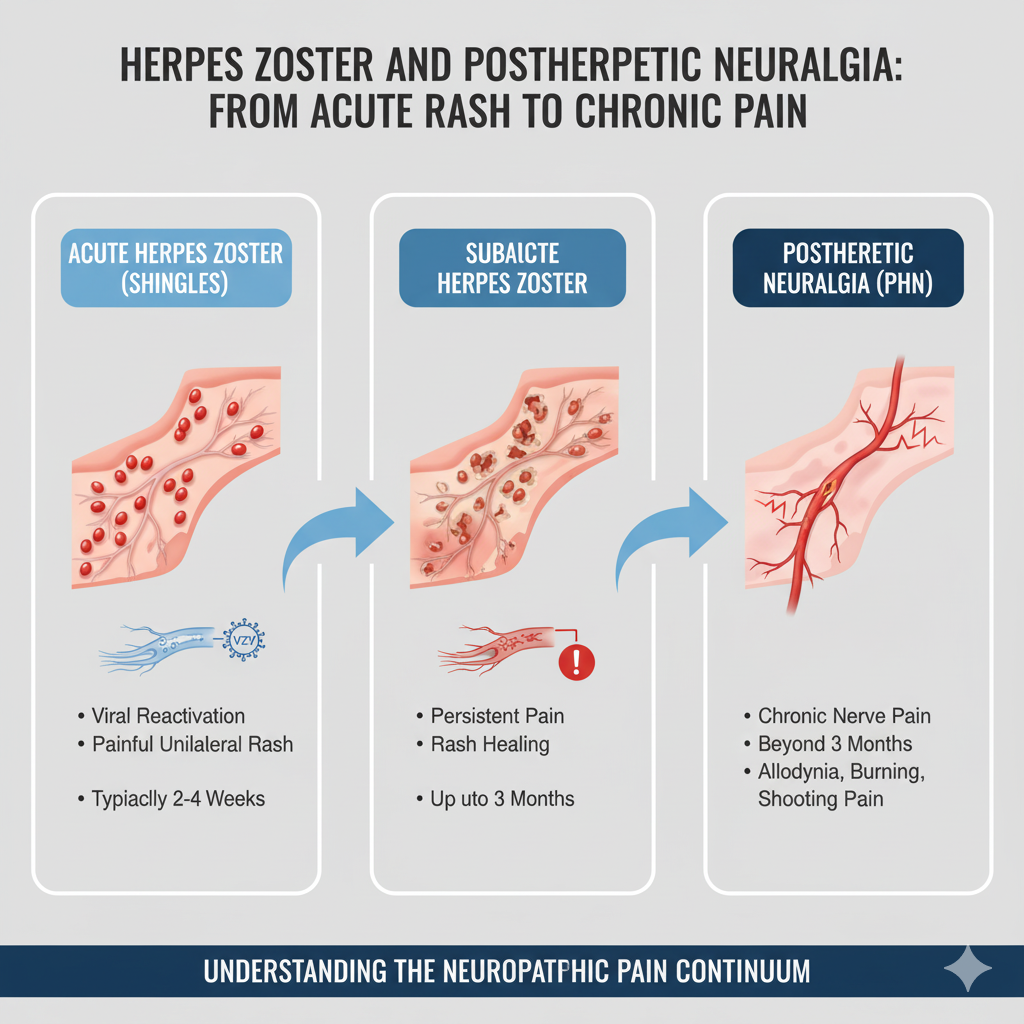
Herpes Zoster, commonly known as shingles, is a painful, unilateral vesicular rash caused by the reactivation of the latent varicella-zoster virus (VZV), the same virus that causes chickenpox. While the acute illness can be debilitating, its most feared and common complication is postherpetic neuralgia (PHN), a chronic neuropathic pain syndrome that can persist for months or even years after the rash has resolved. Understanding the pathophysiology, the urgency of treating the acute phase, and the evidence-based management of the chronic phase is critical for any provider managing pain.
Pathophysiology: From Latency to Reactivation
Following a primary VZV infection (chickenpox), the virus becomes dormant, establishing a lifelong latency within the sensory dorsal root, cranial nerve, and autonomic ganglia. With a decline in cell-mediated immunity, often due to advancing age, immunosuppression, or stress, the virus reactivates.
- Reactivation and Replication: The latent VZV begins to replicate within the ganglion, causing intense inflammation, neuronal damage, and a hemorrhagic neuritis.
- Viral Transport: The virus then travels down the sensory nerve to the corresponding dermatome of the skin, causing the characteristic vesicular rash.
- Transition to PHN: In some individuals, the intense inflammation during the acute phase leads to irreversible nerve damage, including axonal loss and fibrosis. This peripheral nerve injury can trigger central sensitization, a state where the central nervous system becomes hyperexcitable and amplifies pain signals. This maladaptive neuroplasticity is the underlying mechanism of PHN.
Clinical Presentation of Herpes Zoster (Shingles)
The clinical course of shingles is typically distinct.
- Prodrome: The illness often begins with a 2-3 day prodrome of abnormal skin sensations (burning, tingling, itching) and pain in the affected dermatome before any rash appears.
- Acute Eruption: The hallmark is a unilateral, dermatomal vesicular rash that does not cross the midline. The vesicles are initially clear but become pustular and eventually crust over in 7-10 days. The thoracic dermatomes are the most commonly affected.
- Specific Syndromes:
- Herpes Zoster Ophthalmicus: Involvement of the ophthalmic division (V1) of the trigeminal nerve. This is an ophthalmologic emergency as it can lead to vision loss. Hutchinson’s sign—vesicles on the tip of the nose—indicates involvement of the nasociliary branch and has a high correlation with ocular involvement.
- Ramsay Hunt Syndrome (Herpes Zoster Oticus): Reactivation of VZV in the geniculate ganglion. The classic triad consists of ipsilateral facial paralysis, ear pain, and vesicles in the auditory canal and on the pinna.
Management of Acute Herpes Zoster
The primary goals are to accelerate rash healing, reduce the severity and duration of acute pain, and, most importantly, prevent the development of PHN.
- Antiviral Therapy: This is the cornerstone of treatment. Oral antiviral agents (valacyclovir, famciclovir, acyclovir) should be initiated as early as possible, ideally within 72 hours of rash onset, to be most effective at preventing PHN.
- Analgesia: A multimodal approach is recommended. This can include scheduled NSAIDs or acetaminophen, along with early initiation of neuropathic pain agents like gabapentin or pregabalin and tricyclic antidepressants (TCAs) like nortriptyline. Short-course opioids may be necessary for severe pain.
Postherpetic Neuralgia (PHN)
PHN is diagnosed when pain persists for more than 3 months after the onset of the shingles rash.
- Clinical Features: The pain is complex and can have multiple components:
- Constant Pain: A steady, deep, burning, or aching pain.
- Paroxysmal Pain: Intermittent, spontaneous episodes of lancinating, “electric shock-like” pain.
- Allodynia and Hyperalgesia: The hallmark of PHN. Allodynia is severe pain evoked by a normally non-painful stimulus, such as the light touch of clothing or a bedsheet.
Management of Postherpetic Neuralgia
Treatment is aimed at symptom control and improving quality of life.
- First-Line Therapies:
- Gabapentinoids (Gabapentin, Pregabalin): Calcium channel alpha-2-delta ligands that are highly effective for neuropathic pain.
- Tricyclic Antidepressants (TCAs): Amitriptyline and nortriptyline are effective but must be used with caution in the elderly due to side effects (anticholinergic, cardiac).
- Topical Lidocaine 5% Patch: An excellent option for localized PHN, especially in patients with prominent allodynia, due to its low systemic absorption and favorable side effect profile.
- Second-Line Therapies:
- Topical Capsaicin: Available as a low-concentration cream or a high-concentration (8%) patch that must be applied in a clinical setting.
- Opioids: May be considered for refractory pain but should be used cautiously due to risks.
- Interventional Options: For severe, refractory cases, options like sympathetic nerve blocks or spinal cord stimulation may be considered.
Prevention: The Zoster Vaccine
Vaccination is the most effective strategy for preventing both herpes zoster and PHN. The recombinant zoster vaccine (Shingrix) is recommended by the CDC for all immunocompetent adults aged 50 years and older. It is a two-dose series and has demonstrated over 90% efficacy in preventing shingles.
Conclusion
Herpes Zoster is a common and painful condition for which early and aggressive antiviral therapy is paramount to prevent the transition to the often-intractable Postherpetic Neuralgia. The management of established PHN is challenging and relies on a multimodal, evidence-based approach
Neuromuscular Scoliosis and Spasticity-Related Pain: Biomechanics and Management
Pain in children with neuromuscular disorders, such as Cerebral Palsy (CP), Spinal Muscular Atrophy (SMA), or Duchenne Muscular Dystrophy, is often multifactorial and under-recognized. Unlike idiopathic scoliosis, which is rarely painful in adolescence, neuromuscular...
Regional Anesthesia and Procedural Sedation in Children: Safety, Anatomy, and Technique
The use of regional anesthesia in pediatrics has expanded significantly, shifting from strictly "surgical" use to a vital component of chronic and subacute pain management. Whether performing a block for post-operative recovery or providing sedation for a painful...
Explore More
Toxicology and Urine Drug Testing (UDT)
For the pain physician, Urine Drug Testing (UDT) is not a tool for "catching" patients; it is a...
Adjuvant Medications—Alpha-2 Agonists and Steroids
In the pharmacological management of pain, "adjuvant" medications are those primarily indicated...
Topical Analgesics—Lidocaine, Capsaicin, and Compounded Creams
In the modern landscape of pain management, topical analgesics have transitioned from "ancillary"...