

For the pain physician, Urine Drug Testing (UDT) is not a tool for "catching" patients; it is a...
Comprehensive Cancer Pain Management: Principles and Practice
Pain is one of the most feared and prevalent symptoms in patients with cancer, affecting a majority of individuals with advanced disease and a significant portion of cancer survivors. Effective cancer pain management is a clinical and ethical imperative that can dramatically improve a patient’s quality of life, function, and ability to tolerate cancer-directed therapies. Management is multifaceted, requiring a thorough understanding of pain pathophysiology, a systematic approach to assessment, and the judicious use of pharmacologic, interventional, and rehabilitative strategies, all guided by the foundational principles of the World Health Organization (WHO).
Pathophysiology of Cancer Pain
Cancer pain is not a single entity but a complex syndrome that can arise from multiple mechanisms, often concurrently. It is crucial to identify the underlying type of pain to guide treatment.
- Nociceptive Pain: This is the most common type, caused by the direct stimulation of nociceptors.
- Somatic Pain: Arises from the activation of nociceptors in cutaneous or deep musculoskeletal tissues. It is typically well-localized, sharp, or aching. A classic example is pain from a bony metastasis.
- Visceral Pain: Arises from the infiltration, compression, or stretching of thoracic or abdominal organs. It is often poorly localized, deep, cramping, or gnawing and may be referred to distant sites. Pain from pancreatic cancer is a prime example.
- Neuropathic Pain: This results from injury or dysfunction of the peripheral or central nervous system. It can be caused by tumor compression of a nerve plexus (e.g., Pancoast tumor affecting the brachial plexus), spinal cord compression, or as a side effect of treatment (e.g., chemotherapy-induced peripheral neuropathy). The pain is often described as burning, tingling, shooting, or “pins and needles.”
The WHO Analgesic Ladder
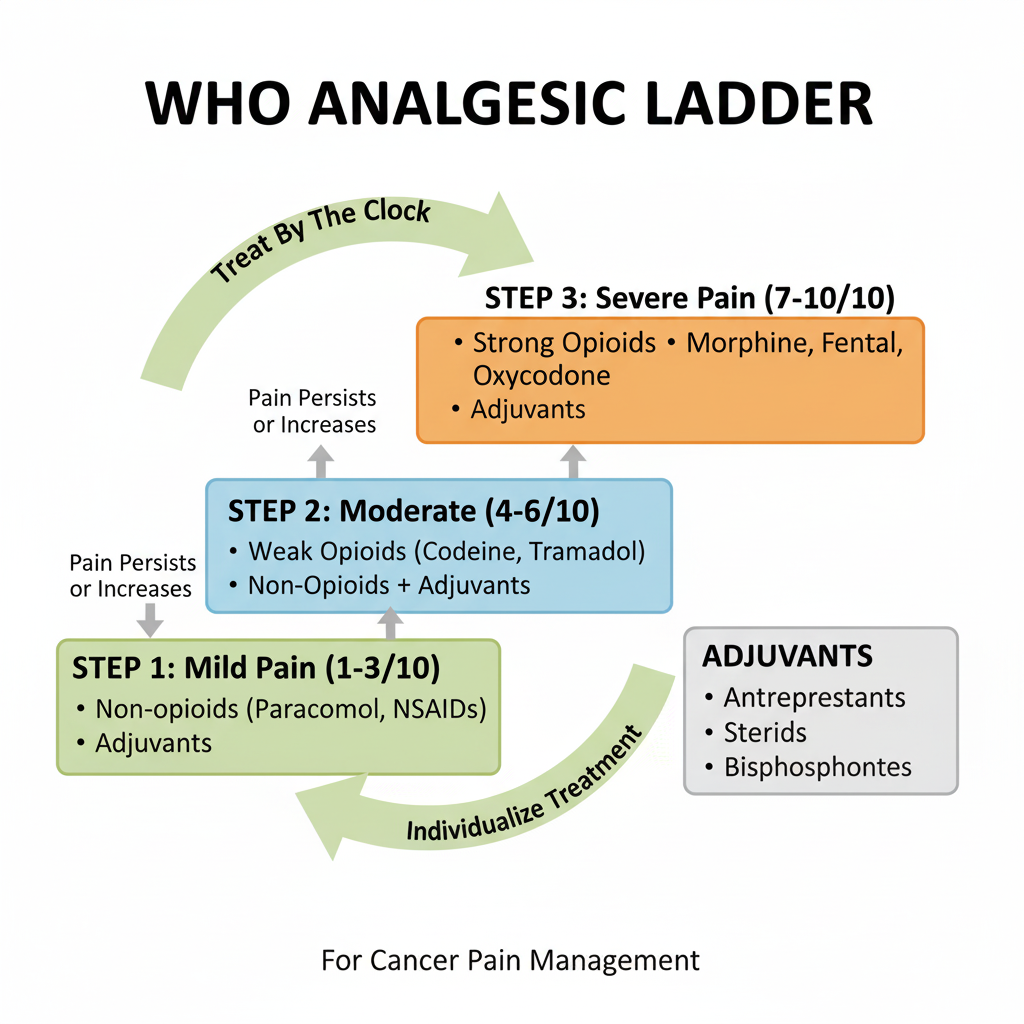
The WHO three-step analgesic ladder, first published in 1986, remains the fundamental framework for the pharmacologic management of cancer pain. While modern practice has evolved, its principles of a stepwise, patient-centered approach are timeless.
- Step 1 (Mild Pain, 1-3/10): Start with non-opioid analgesics like acetaminophen or NSAIDs, with or without an adjuvant analgesic.
- Step 2 (Moderate Pain, 4-6/10): If pain persists or increases, add a “weak” opioid for moderate pain, such as codeine or tramadol. (Note: In modern practice, this step is often skipped in favor of low-dose Step 3 opioids).
- Step 3 (Severe Pain, 7-10/10): If pain continues to be moderate or severe, switch to a “strong” opioid, such as morphine, oxycodone, hydromorphone, or fentanyl.
The guiding principle is to treat “by the clock” (scheduled, around-the-clock dosing) to maintain a steady analgesic level, with as-needed “breakthrough” doses available.
Pharmacologic Management
1. Opioid Therapy: The Cornerstone Opioids are the mainstay for moderate to severe cancer pain.
- Dosing: There is no ceiling effect for pure opioid agonists in cancer pain. The dose should be titrated upwards until pain is controlled or side effects become intolerable.
- Long-Acting (LA) and Short-Acting (SA) Opioids: The standard of care is to use a scheduled LA opioid for baseline pain control and a SA opioid of the same chemical class for breakthrough pain. The breakthrough dose is typically calculated as 10-15% of the total 24-hour opioid dose.
- Opioid Rotation: If a patient develops tolerance or intolerable side effects to one opioid, switching to another (opioid rotation) can often improve the balance between analgesia and side effects. This requires the use of equiannalgesic conversion tables, typically with an empirical dose reduction of 25-50% for incomplete cross-tolerance.
- Side Effect Management: Proactive management is critical. Opioid-induced constipation is nearly universal and does not resolve with time; a scheduled bowel regimen (stimulant + softener) must be started with the opioid. Other common side effects include nausea, sedation, and pruritus.
2. Adjuvant Analgesics These are drugs with a primary indication other than pain but are analgesic in specific circumstances, often targeting neuropathic or bone pain.
- For Neuropathic Pain:
- Anticonvulsants: Gabapentin and pregabalin are first-line agents.
- Antidepressants: TCAs (nortriptyline, desipramine) and SNRIs (duloxetine, venlafaxine) are also effective.
- NMDA Antagonists: Methadone (which has opioid and NMDA antagonist properties) and ketamine are useful for complex, refractory neuropathic pain.
- For Bone Pain:
- Bisphosphonates (e.g., zoledronic acid) and Denosumab (a RANKL inhibitor) can reduce pain from lytic bone metastases and prevent skeletal-related events.
- Corticosteroids (e.g., dexamethasone) are highly effective for reducing inflammation and edema around tumors, which can rapidly relieve pain from bone metastases and nerve compression.
- Radiotherapy is also a mainstay for localized, painful bone lesions.
Interventional Cancer Pain Management
For pain that is refractory to conservative pharmacologic management or when side effects are intolerable, interventional techniques can provide significant relief.
- Neurolytic Blocks: For visceral pain, chemical neurolysis of sympathetic plexuses can provide profound, long-lasting analgesia. The most common procedures are the celiac plexus block for upper abdominal pain (e.g., pancreatic cancer) and the superior hypogastric plexus block for pelvic pain.
- Intrathecal Drug Delivery: An implanted pump delivers microdoses of medication (e.g., morphine, ziconotide) directly into the cerebrospinal fluid, providing potent spinal analgesia with fewer systemic side effects.
- Vertebral Augmentation (Vertebroplasty/Kyphoplasty): For painful vertebral compression fractures from metastatic disease, injecting bone cement into the vertebral body can stabilize the fracture and provide rapid pain relief.
Conclusion
By correctly identifying the pain mechanism, applying the principles of the WHO ladder, and skillfully using a combination of opioids, adjuvant analgesics, and interventional procedures, clinicians can alleviate suffering and restore dignity and quality of life for patients living with cancer.
Neurochemistry of Pain: Primary Neurotransmitters
The neurochemistry of pain is a delicate balance between excitatory signals that drive nociception and inhibitory signals that provide analgesia. These neurotransmitters are the molecular targets for almost every pharmacological intervention, from the NMDA-antagonism...
Autonomic Nervous System (Sympathetic vs. Parasympathetic)
In the realm of pain medicine, the Autonomic Nervous System (ANS) is far more than just the "fight or flight" controller. It is a major player in the pathophysiology of complex regional pain syndrome (CRPS), visceral pain, and the systemic response to chronic stress....
Explore More
Toxicology and Urine Drug Testing (UDT)
For the pain physician, Urine Drug Testing (UDT) is not a tool for "catching" patients; it is a...
Adjuvant Medications—Alpha-2 Agonists and Steroids
In the pharmacological management of pain, "adjuvant" medications are those primarily indicated...
Topical Analgesics—Lidocaine, Capsaicin, and Compounded Creams
In the modern landscape of pain management, topical analgesics have transitioned from "ancillary"...